
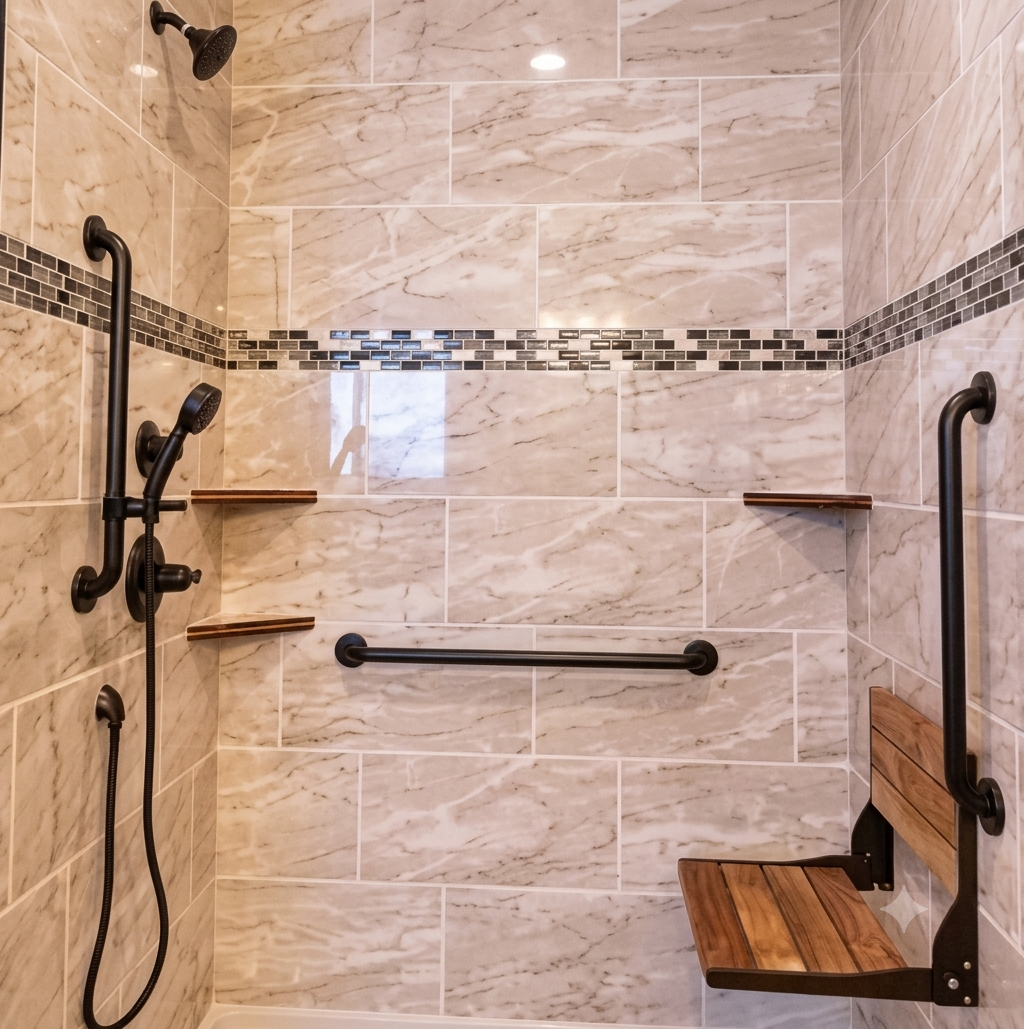

A grab bar only works if it's placed, sized, and anchored to spec. These are the baseline figures we check on every install, and the reasoning behind each one.
Measured from the finished floor to the top of the gripping surface. This range keeps the bar reachable whether someone is pushing up from a seated position or steadying themselves while standing.
Thin enough that most adult hands can close fully around it, thick enough that it doesn't flex under a sudden load. Anything much thinner or thicker reduces grip security.
The gap kept between the bar and the wall behind it, so fingers can wrap all the way around without knuckles scraping the wall surface.
The baseline force a properly stud-anchored bar and its mounting hardware must withstand. Most of our Moen grab bars are rated well above this floor, up to 500 lbs.
Drywall anchors alone can't reliably hold a load-bearing grab bar. Every install we do locates and anchors into structural studs or blocking, not just the wall surface.
A grab bar mounted 6 inches off spec, or into drywall instead of a stud, can fail exactly when it's needed most. That's the whole reason we measure and confirm stud locations on every visit before drilling — see our full grab bar lineup for the styles we install to these standards.
Not safely -- drywall anchors can't reliably hold body weight under a sudden load. We always locate and anchor into studs or blocking.
We use blocking or a mounting plate rated for the load, confirmed on site before installation.
Every bar is torque-checked at mounting, and the hardware itself is rated by the manufacturer to the figures listed here.
We'll tell you honestly if what's already installed meets code.